.png)

In partnership with


25 yrs
In New Zealand schools
1K+
School staff trained
250+
Schools across Aotearoa
$3.30
Social return per $1 invested
A space to figure things out together
Travellers is a small group of 8–10 students who meet at school for about 90 minutes a week, for 10 weeks. Two trained staff from your child’s school run each group.
The sessions are practical and creative. There’s discussion, drawing, movement, games, and time to reflect. Students learn how feelings work, how to handle stress, how to talk to themselves more kindly, and who to lean on when things get hard. Most importantly, they learn it together.
Travellers has been running in schools across Aotearoa since 2001. It was developed by Skylight Trust in partnership with Te Herenga Waka - Victoria University of Wellington, and is funded by Health New Zealand - Te Whatu Ora.
What young people who’ve done it say
“I get on with teachers now. I didn’t get on with them before Travellers. I talk to my form teacher about stuff now. In Travellers, we try to open our hearts to each other and solve common problems together. I could share my feelings and it was kept personal. It’s great.”
Alexia
“It's helped me realise I'm not alone and that you shouldn't judge a book by its cover because loads of people go though horrible things and you wouldn't be able to tell from looking at them. Basically it's helped me be more open minded.”
Riley
"Travellers has helped me to realize that having emotions are good and how to deal with them in a healthy way. It also helped me with being a more positive person and reflecting that positivity on others by helping them"
Eraiah
A meaningful step at an important time
Year 9 is one of the bigger transitions in a young person’s life. New school, new friendships, more independence, and the start of figuring out who they are. Travellers is designed to meet young people in that moment with practical skills they can use for years to come.
Schools choose who to invite using two things: a short, confidential wellbeing survey that every Year 9 completes, and the professional judgement of the staff who know your young person. The goal is to invite young people who’d benefit from learning these skills early, in a small group of peers who are doing the same.
What young people often tell us afterwards is that the most powerful part of Travellers was simply realising they weren’t the only one feeling like this. They came in thinking they were alone with something, and left with a group of mates who’d been carrying their own versions of the same thing.
according to Independent evaluations
Students experience
Increased confidence and self-belief
New friendships and more connectedness in school
Improved ability to cope with stress and change
Greater emotional awareness and healthier expression
Increased willingness to seek help and talk about feelings
Developed by Skylight Trust
Skylight Trust is a national not-for-profit that specialises in helping tamariki, rangatahi, and whānau navigate tough times.
We provide counselling (in person and online), group programmes, resources, and training for professionals. We believe no one should face grief, loss, or change alone. Visit www.skylight.org.nz to learn more.

24k+
Hours of therapy each year
400+
Families supported per month
60+
Counsellors available
Two parts that work together
.png)
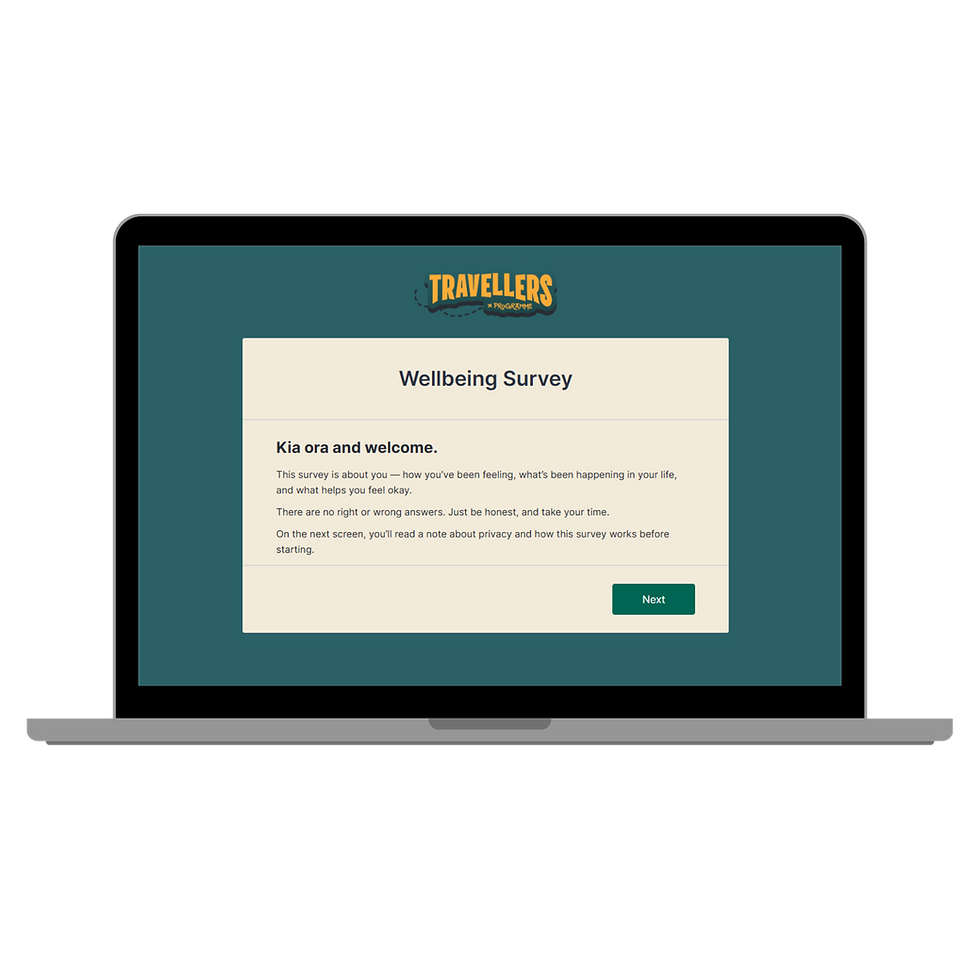
Part 1 · Wellbeing Survey
A confidential check-in for every Year 9
Before the groups start, every Year 9 completes a short, confidential survey about how they're doing: things like how they're feeling, how they're sleeping, and whether they feel they belong.
It's not a test, and it doesn't go on any record. It simply helps the school get a clearer picture of how their young people are travelling, and who might most enjoy and benefit from a group.
PArt 2 · Group Programme
Ten weekly sessions Built around the metaphor 'life is a journey'
A small group of 8–10 students meets at school for about 90 minutes a week, over ten weeks, led by two trained staff who already know the school community.
The sessions are practical and creative: discussion, drawing, movement, and time to reflect. Young people learn how feelings work, how to handle stress, how to be kinder to themselves, and who to lean on when things get hard. And often the biggest thing they take away is simply realising they're not the only one.

Ten weeks. Ten themes. One journey.
Each session focuses on a single, age-appropriate theme. The skills build on each other so that by the end of the 10 weeks, your young person will have a toolkit they can keep using. Here’s an overview of each session.
Young people are welcomed into the group and begin getting to know each other through games, shared kai, and simple activities. Facilitators explain what Travellers is, why students have been invited, and what they can expect over the next ten weeks. The group co-creates expectations around respect and confidentiality.
Life is a journey
Students explore the idea that life includes ups and downs, changes, and challenges, and that no one travels alone. The group creates shared safety guidelines (kawa) and begins using personal travel diaries for reflection. A creative activity introduces the metaphor of life as a journey.
He waka eke noa - We are all in this together
Your story can change
Students create their own life maps: visual representations of important experiences, challenges, and milestones in their lives. Facilitators model safe sharing first, then students work creatively using drawing, collage, or symbols. The emphasis is on meaning-making and how they choose to understand their own story.
Titiro whakamuri, kōkiri whakamua - We look back and reflect so that we can move forward
Feelings are clues
This session builds emotional literacy. Students learn a wider vocabulary for feelings, explore where emotions show up in their bodies, and practise recognising different emotional states. They begin connecting feelings with underlying needs of safety, rest, connection, support.
Whāia te mātauranga hei oranga mō te katoa - Pursue learning for the sake of everyone's wellbeing
Express yourself
Students explore healthy ways to express emotions instead of bottling them up. They learn the difference between validating and invalidating responses, and practise what supportive listening sounds like. The group experiments with physical, creative, and calming ways of releasing strong feelings.
Hurihia tō aro ki te rā, tukuna tō ātārangi kia taka ki muri i a koe - Turn your face to the sun and the shadows will fall behind you
Thoughts can be challenged
This session introduces the idea that thoughts are not always facts. Students explore how thoughts, feelings, body sensations, and behaviours are connected. They learn a simple process (catch it, challenge it, change it) to build flexible, realistic thinking.
Ko au te waiora o aku whakaaro - I am the wellbeing of my thoughts
Be your own best friend
Young people explore what self-esteem is and where it comes from. Activities focus on identifying internal qualities like kindness, courage, persistence, rather than only external achievements. Students reflect on how social media, comparison, and self-talk shape how they feel about themselves.
He aroha whakatō, he aroha puta mai - If kindness is sown, then kindness you shall receive
Travel with care
Students learn about wellbeing as something they can actively look after. Using Te Whare Tapa Whā, they explore physical, emotional, social, and spiritual wellbeing. They identify personal strategies for sleep, movement, creative outlets, time with others and build small, achievable habits.
He oranga ngākau he pikinga waiora - Pleasant feelings in your heart will enhance your self-worth and overall wellbeing
Build your support team
This session focuses on connection and support. Students explore what healthy relationships look like, how to communicate needs, and who they can turn to for help. They map their own support networks and practise thinking about when and how to reach out.
Nā tō rourou, nā taku rourou ka ora ai te iwi - With your offering and my offering the people will thrive
You've got this!
The final session looks back on the journey and celebrates progress. Students reflect on what they have learned, the skills they have developed, and changes they have noticed in themselves. The group acknowledges each other's efforts and ends with a shared celebration.
Ko te pae tawhiti whāia kia tata, ko te pae tata whakamaua kia tīnā - Strive to overcome challenges and celebrate successes
Grounded in aotearoa
Travellers grew up here. It's run in Aotearoa schools for 25 years, and was recently redeveloped with Te Herenga Waka, Victoria University of Wellington. As part of that refresh, we worked with cultural advisors to deepen the cultural integrity, safety, and embodied practice in every session. Here's some of what that looks like.
1
GUIDED BY CULTURAL ADVISORS
Cultural advisors shaped the refresh from the ground up, making sure every practice is culturally safe, authentic, and woven in with intention
2
KARAKIA AS GROUNDING
Each session opens with a simple karakia for breath, grounding, and intention. They are embodied, so students feel it through movement, not just words.
3
A MAURI CHECK-IN
A short, private moment for students to notice how they're feeling before the mahi begins. Nobody has to share; it's simply a chance to arrive with awareness.
4
FOUR WALLS, ONE WHARE
Te Whare Tapa Whā runs as a thread through the whole programme, taha tinana, hinengaro, whānau, and wairua, woven into activities and reflection rather than taught as a one-off.
5
WORDS THAT ANCHOR LEARNING
Whakataukī chosen to match each theme appear throughout the sessions and materials, anchoring the learning in cultural meaning.
6
WELCOMING & CLOSING RITUALS
Schools can open with a mihi whakatau to acknowledge people, place, and purpose, and close with a spacious poroporoaki where students reflect, speak, share kai, and finish the journey together.
How you can support your young person
We like to share what your young person is learning so you can be there for them during the programme. The most powerful thing you can do is stay curious, listen without rushing to fix things, and notice when they try out something new.
Listen first, suggest later
“That sounds really hard” lands better than “Have you tried…?” Solutions feel more useful once a young person feels properly heard.
Be one of several safe adults
Young people need more than one trusted person. Encourage connection with aunties, uncles, grandparents, neighbours, coaches.
Notice the effort, not just the outcome
Trying matters, even when the result doesn’t change. Naming the attempt out loud is one of the simplest ways to build confidence.
Keep the everyday steady
Sleep, meals, downtime, and small rituals do more than big conversations. Predictability is a quiet form of safety.
Don’t push for a debrief
If your child wants to share what happened in the group, they will. If they don’t, that’s okay too. The confidentiality of the group is part of what makes it work.
This program helped me with dealing with certain situations that I'd often have a hard time dealing with. It taught me how to calm down when I was stressed/upset and how to react when certain situations arise. It made me feel safe to share any problems I had because everyone else was very comfortable with themselves, and that made my issues feel much more secure and valid when sharing them.
Taine
Student
Proven, trusted, and grounded in Aotearoa
A few things that set Travellers apart from other wellbeing programmes:
1
Proven over time
Supporting young people across Aotearoa since 2001.
2
Research-informed
Developed with Te Herenga Waka — Victoria University of Wellington.
3
Early intervention focus
Identifies need early and prevents escalation.
4
Builds school capability
Staff are trained to deliver sustainably so the capability stays in your school.
5
Culturally grounded
Incorporates Te Ao Māori and Te Whare Tapa Whā.
6
The return is measurable
$3.30 of social value for every $1 invested (ImpactLab, 2024).
We have 500 students in our Year 9 intake. We get an enormous amount of valuable information, particularly on the high-risk group, within three weeks of starting school. They build a relationship with the facilitators, so they know where to come when something happens. They bring friends. They tell me about people in trouble. For me, the programme is an investment that pays a dividend for five years and sometimes longer.
Terry McCain
Guidance Counsellor
Questions you may have
Take the brochure with you
A printable parent brochure that walks through the same programme overview, the 10-week journey, and the questions whānau most often ask. Useful to share with the rest of the household, or to come back to during the term.
For any questions, please speak to your school counsellor or pastoral lead.